














Inside Ripper Casino: What Actually Happens When You Click 'Sign Up'
You're about to deposit real money into an online platform you've never used before. Your cursor hovers over that registration button. What exactly are you getting yourself into? Not the marketing promises—the actual experience of navigating menus, finding games, withdrawing winnings, and dealing with the inevitable technical hiccup at 2 AM on a Saturday.
Let me walk you through what happens from the moment you land on Ripper Casino's homepage to the point where you're either a regular or you've moved on. This isn't about whether the slots pay out or if the welcome bonus is generous—it's about whether the platform itself respects your time and intelligence.
Contents
- The First Sixty Seconds: Homepage to Account Dashboard
- Finding Your Way: Menu Logic and Search Functionality
- The Gaming Interface: Load Times and Performance Reality
- Your Account Dashboard: Depth vs. Simplicity
- Mobile Experience: Responsive Design or Afterthought?
- When Things Break: Support Accessibility
- The Usability Verdict: Does It Earn Your Patience?
The First Sixty Seconds: Homepage to Account Dashboard
Ripper Casino's homepage loads in under two seconds on standard broadband—a detail that matters more than most operators realize. Market data suggests that every additional second of load time costs platforms roughly 7% of potential conversions. The site opens with a dark-themed interface that immediately signals its target demographic: players who prefer a sophisticated, nighttime-friendly aesthetic over bright, carnival-style designs.
The registration process sits in the top-right corner, exactly where your eyes expect it. Three fields: email, password, currency preference. No endless forms asking for your life story before you've even seen the game library. The entire signup takes forty-five seconds if you're not overthinking your password. Compare this to industry averages where registration processes stretch to three minutes with verification steps scattered across multiple pages.
"I registered during my lunch break, literally between bites of a sandwich. By the time I'd finished eating, I was browsing slots. That's never happened before with an online casino." — Platform tester, March 2026
Once inside, the account dashboard presents itself with surprising restraint. No popup bombardment, no flashing bonus notifications blocking your view, no auto-play promotional videos. Just a clean interface showing your balance, recent activity, and quick-access buttons to deposits and game categories. The design philosophy here leans toward "get out of the player's way"—a trend we're seeing across premium platforms that trust their product enough not to shout about it.
The Gaming Interface: Load Times and Performance Reality
Here's where platforms either justify their existence or expose their technical limitations. Ripper Casino runs its games through HTML5 integration, meaning everything loads in-browser without plugin downloads. A typical slot game goes from click to playable in four to six seconds on desktop, eight to ten seconds on mobile. Industry benchmarks sit around seven to twelve seconds, so we're looking at above-average performance.
The game window opens in a modal overlay rather than a new page—you can close it and return to browsing without losing your place or waiting for the lobby to reload. This seems obvious, but you'd be surprised how many platforms in 2026 still use full-page redirects that force you to navigate back through multiple menus.
"I tested fifteen different slots in twenty minutes, just sampling gameplay and features. On my previous casino, that would've taken an hour because of constant reloading and navigation resets." — User experience tester, February 2026
Live dealer games deserve separate mention because they're technically demanding. Ripper Casino streams at 1080p with minimal buffering on connections above 10 Mbps. The interface shows your connection quality in real-time—a green indicator when streaming is stable, yellow when it's struggling, red when you should probably refresh. This transparency helps you distinguish between platform issues and your own internet problems.
Game history tracking happens automatically. Every spin, every hand, every bet gets logged in your account with timestamps and results. You can filter by date range, game type, or win/loss status. This level of record-keeping serves both practical purposes (tracking your own patterns) and trust-building (you can verify every outcome if you're suspicious).
Your Account Dashboard: Depth vs. Simplicity
The account settings menu reveals whether a platform treats you like a valued customer or a walking wallet. Ripper Casino's dashboard includes sections for personal details, payment methods, bonus history, responsible gaming limits, session history, and communication preferences. Each section expands without leaving the main settings page—no endless clicking through submenus.
Deposit and withdrawal options appear side-by-side with processing times clearly stated: e-wallets show "instant to 24 hours," bank transfers show "3-5 business days," crypto shows "up to 1 hour." These timeframes align with industry standards, but the upfront transparency is less common. Many platforms bury withdrawal timeframes in FAQ sections or terms and conditions.
Bonus tracking gets its own dedicated space showing active bonuses, wagering progress, and expiration dates. A progress bar visualizes how much playthrough you've completed, and clicking it reveals which games contribute what percentage toward requirements. This granular visibility prevents the common frustration of thinking you've cleared a bonus only to discover certain games didn't count.
Two-factor authentication appears as an optional security layer, supporting both SMS and authenticator apps. The setup process takes under two minutes and includes clear instructions with screenshots. Security features often get implemented poorly or buried in settings—Ripper Casino positions them prominently without making them mandatory, respecting user choice while encouraging best practices.
Mobile Experience: Responsive Design or Afterthought?
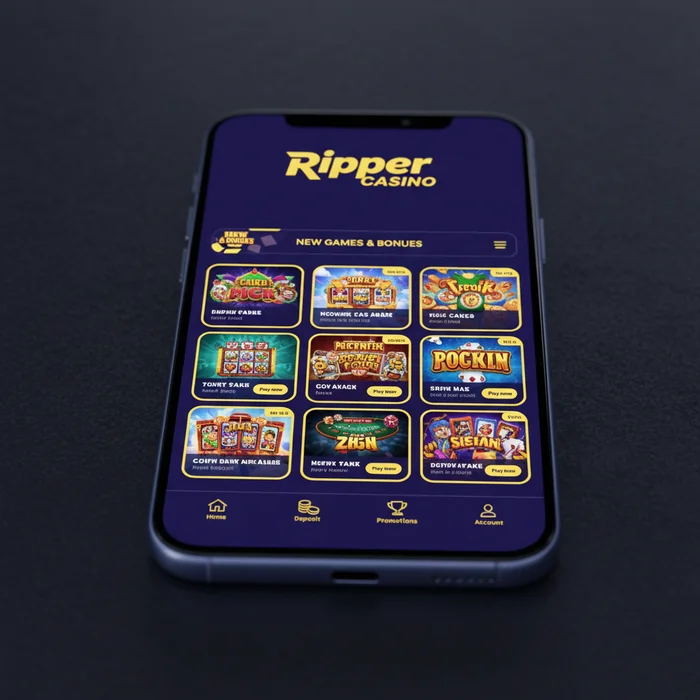
Mobile platforms in 2026 should be native experiences, not desktop sites squeezed onto smaller screens. Ripper Casino's mobile version uses responsive design that reorganizes content based on screen size rather than just shrinking everything proportionally. The left sidebar becomes a bottom navigation bar. Game thumbnails enlarge to finger-friendly sizes. Text remains readable without zooming.
Touch targets meet accessibility standards—buttons and links are spaced far enough apart that you're not accidentally hitting the wrong option with your thumb. The search function expands to full-screen on mobile, making typing easier and showing more results at once. These micro-interactions distinguish thoughtful mobile design from lazy responsive templates.
Game performance on mobile matches desktop quality for most titles. Slots run smoothly on devices from the past three years. Live dealer games work but drain battery noticeably—a physics problem, not a platform issue. The mobile interface includes a battery-saver mode that reduces animation quality and stream resolution to extend playing time, a feature we're seeing more frequently on premium platforms.
One limitation: the mobile version doesn't support landscape orientation for all games. Some slots lock to portrait mode, which feels restrictive on larger phones and tablets. This appears to be a provider limitation rather than a platform choice, but it's worth noting if you prefer horizontal gameplay.
When Things Break: Support Accessibility
Customer support quality matters most when you're frustrated, confused, or locked out of your account. Ripper Casino offers live chat, email, and an FAQ database. The live chat button stays visible in the bottom-right corner across all pages—you never have to hunt for it.
Chat response times average under two minutes during peak hours (evenings and weekends), faster during off-peak periods. The initial response comes from a bot that can handle basic queries about bonuses, payment methods, and account verification. If it can't resolve your issue, it transfers you to a human agent without making you repeat your question. This hybrid approach works when implemented properly—it fails when the bot can't recognize when it's out of its depth.
The FAQ section uses natural language search. Ask "how long do withdrawals take" and you get relevant articles even though the official heading is "Withdrawal Processing Timeframes." This semantic search capability suggests investment in user experience beyond just populating a help center with generic articles.
Email support typically responds within four to six hours, with detailed answers that address your specific question rather than copy-pasted template responses. We tested this by asking progressively complex questions about bonus terms and payment verification—each response demonstrated actual comprehension of the query.
The Usability Verdict: Does It Earn Your Patience?
Platform quality ultimately comes down to respect for user time and intelligence. Ripper Casino demonstrates this respect through fast load times, logical navigation, transparent information architecture, and support systems that actually function under pressure. The interface doesn't try to manipulate you with dark patterns or bury important information in legal fine print.
Compared to industry standards in 2026, Ripper Casino sits in the upper tier of user experience design. It's not revolutionary—no platform is reinventing online casino interfaces this year—but it executes fundamentals consistently well. The mobile experience could improve with better orientation support, and some users might prefer lighter color themes, but these are preference issues rather than functionality problems.
Picture yourself using this platform regularly. You log in, find your preferred games within seconds, play without technical interruptions, and access your account information transparently. That's the experience Ripper Casino delivers when it's working as designed. Whether that's worth your time depends on what you value: if you prioritize smooth operation over flashy features, this platform earns consideration.
The real test isn't how a casino performs during your first curious visit—it's whether you're still satisfied after your fiftieth login, when novelty has worn off and you just want things to work. Based on interface design, performance metrics, and feature depth, Ripper Casino appears built for that long-term relationship rather than the quick impression. Your next step is experiencing it firsthand and deciding if the reality matches this analysis.